Power Loss, Gradius Syndrome, and the Value of a Bad Run

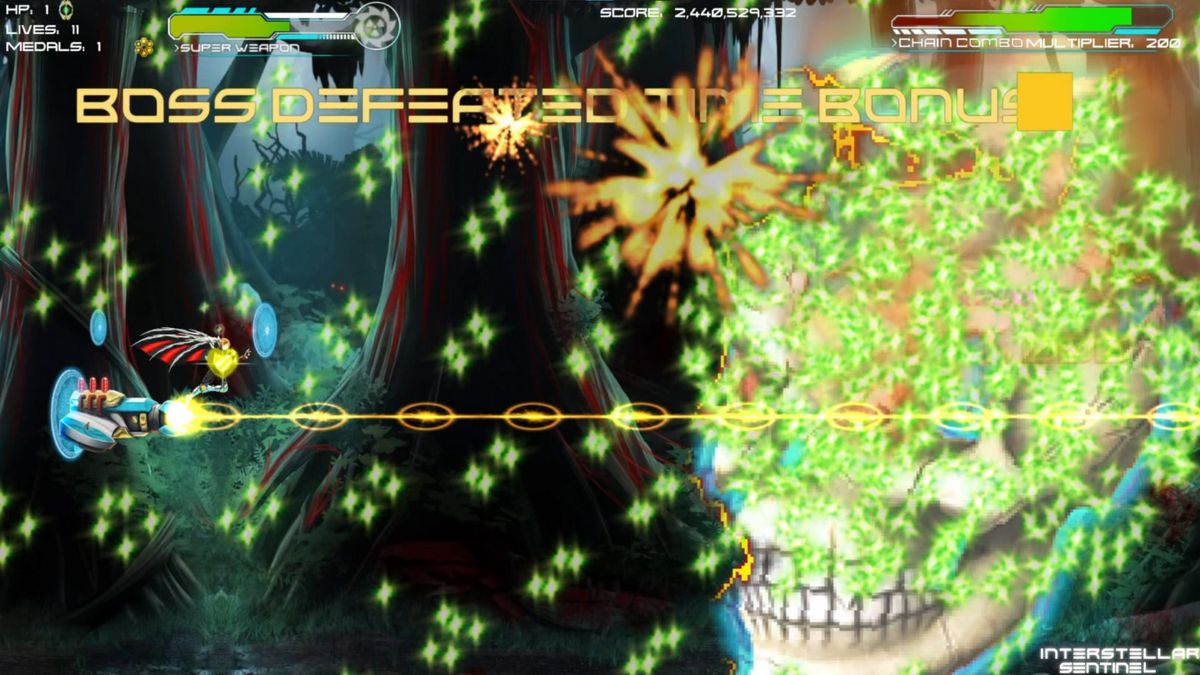
A question popped up in the Shmup Creator Discord recently:
How do you feel about losing your power-ups after dying in a shmup?
The responses were interesting. Power loss was called illogical, unnecessarily punitive, difficult to balance, momentum-killing, and ultimately a relic of old arcade design.
None of those criticisms are without merit. We have all played shmups where one death leaves you limping into a late-game checkpoint with the combat capabilities of an angry paper airplane. You technically have two lives left, but we all know how this story ends.
Still, I personally think that with no risk, there’s no reward. You lose the high highs and the low lows. Being locked in a flow state that is continuing to build momentum to the high highs is meaningless if it can all blow up on you the moment you lose focus, and there is no loss of reward. There is also the illusion of perceived risk that can pay off as long as the player doesn't know the illusion is just that. I once accidentally released a build with 10k player HP, and some of our players were the best they'd ever been and felt great because they weren't dying. Until I mentioned the build had this bug that made it impossible for them to die, their faces instantly switched to sad panda face, but just for a moment they were feeling like they had finally made it to another level of skill.
Power loss is harder to balance around. The bad version can absolutely turn one mistake into a miserable death spiral, something shmup players have come to call Gradius Syndrome.
But that doesn’t make the mechanic inherently archaic.
To me, the interesting part is designing a meaningful setback while still giving the player a believable route back into the run.
What Is Gradius Syndrome?
Gradius Syndrome, also called Power-Up Syndrome or the “one-life game” problem, is an informal shmup-community term for games where dying removes most or all of the player’s upgrades and recovering afterward becomes extremely difficult to the point where they feel it's nearly impossible. Some people just quit and restart. Gradius and Darius II are commonly cited examples.
The classic version goes something like this:
You spend several stages building your ship into a magnificent space murder machine. You have speed upgrades, missiles, lasers, Options, a shield, and enough firepower to turn the screen into soup.
Then you die.
The game sends you back to a checkpoint with your starting weapon and movement speed. Unfortunately, the enemies, terrain, and stage pacing are still expecting the fully upgraded murder machine.
The result is not merely that the game becomes harder. It may become dramatically harder than it was before you died.
Your remaining lives begin disappearing one after another. Extra lives barely function as extra chances because the first death removed the tools you needed to use them. The run has effectively become a one-life run, whether the game admits it or not.
That is the actual design problem.
Gradius Syndrome is not simply losing power when you die. It is the mismatch between the condition in which the player respawns and the condition the game expects them to be in.
You are technically alive.
Practically speaking, you may already be dead.
A Setback Is Not the Same as a Death Spiral
This distinction matters because discussions about power loss often collapse two different ideas into one.
The first is a meaningful setback.
The player dies, loses something valuable, and must adapt. They may need to rebuild their weapon, change their route, use a bomb defensively, survive long enough to reach the next power-up carrier, or squeeze more utility out of their base equipment.
The second is a soft game over.
The player dies, loses everything, and gets dropped into a situation that provides no realistic recovery path. Their remaining lives are mostly there to prolong the funeral.
Those are not the same design.
The existence of the second does not invalidate the first.
It just means that power loss creates a recovery problem that the designer has to solve.
Power Is More Interesting When It Can Be Lost
Power-ups are often treated as a simple progression meter.
Collect enough items and the number goes up. Your bullets get larger. Your spread gets wider. Your damage increases. Eventually you reach maximum power and stay there until the game ends.
That can work perfectly well.
But when power can be lost, the upgrade system takes on another dimension. The player is no longer only building power. They are protecting it.
Suddenly the fully upgraded ship is not merely the inevitable final form of the player’s weapon. It is a state they reached, earned, and now have a reason to preserve.
That creates tension.
A player entering a difficult boss at maximum power feels something different from a player entering with nothing to lose. The possibility of failing creates value in what they are carrying.
There is now something at stake beyond a life icon in the corner of the screen.
That risk also keeps the upgrade loop interesting because you have something to build toward, something worth protecting, and sometimes a little comeback story when it all goes wrong.
That is part of my own secret sauce in games.
Recovery Is Part of the Mechanic
Of course, “the player can recover” is easy to say.
Technically possible is not the same as reasonably possible.
A recovery path does not have to be easy, but it should be legible. The player should be able to look at the situation and understand that a comeback exists, even if they do not yet have the skill to execute it.
There are plenty of ways to build that path.
The base weapon can remain strong enough to kill essential enemies. Power-up carriers can appear shortly after death. More side grade utility than raw power curve. The player can drop only part of their accumulated power instead of losing everything. A death can produce a recovery item. Bombs can convert bullets into upgrade resources. Dynamic difficulty can ease slightly. Checkpoints can be placed in spaces deliberately constructed for rebuilding.
Lower power can also change the weapon’s utility rather than simply making it worse.
Maybe higher levels increase coverage but not basic survival damage. Maybe the lower-level weapon is narrow but concentrated. Maybe advanced players intentionally manipulate their power state because each level creates different tactical possibilities.
That is much more interesting than a meter where every step is simply the previous weapon plus ten percent.
Even the humble mercy power-up that appears after death can do a lot of work. It communicates that the game intends for the run to continue.
The player still has to earn the recovery, but the designer has not abandoned them beside the road with a peashooter and a heartfelt wish for good luck and poster held high with two blazing middle fingers waving.
The Value of a Bad Run
I think there is value in a run going badly.
Not every run needs to be a smooth upward curve. Sometimes the memorable part is losing your fully powered ship, scraping together two upgrades, burning your final bomb, and somehow limping into the boss.
Sometimes the comeback is more exciting than the clean run.
A bad run can force improvisation. It can test route knowledge, resource management, weapon understanding, and composure. It can reveal whether the player only knows how to play from a position of strength.
That does not mean every catastrophic run is secretly good design.
Sometimes you really are just screwed.
But eliminating the possibility of a bad state also eliminates the possibility of escaping one.
Designers should be careful about sanding every sharp edge off an experience because some players might bounce against it. Friction is not automatically depth, but friction is also not automatically a mistake.
Sometimes the sharp edge is where the game lives.
We Can Design Anything We Want
Technically, we can design anything we want.
We could give the player one weapon that never changes, infinite bombs, and no meaningful loss state.
Could that be fun?
Sure.
There are players who want a lower-pressure experience. They may want the spectacle, music, movement, explosions, and feeling of flying through a cool science-fiction world without having the game repeatedly kick them in the teeth.
That is a legitimate experience to design.
Easy games are not automatically boring, just as difficult games are not automatically interesting. A game becomes boring when it stops giving the player a reason to care: no meaningful goals, decisions, surprises, discoveries, expressions of skill, or changes in the experience.
An “I win” button might be fun to press.
Some of my friends would press that thing quite a bit.
But eventually, unless something interesting is happening around it, the button stops meaning anything.
That is the trick for us as designers: deciding what kind of journey we are building, then setting up enough goals, consequences, recovery opportunities, and progressive challenge to guide the player through what can ultimately become a skill-up journey.
What Kind of Journey Are You Building?
The question is not whether power loss belongs in every modern shmup.
It doesn’t.
The question is whether power loss supports the specific experience you are trying to create.
Are you building a game about maintaining flow and momentum? Full power retention may make sense.
Are you building a game around weapon experimentation? Perhaps death should change the player’s available tools rather than simply weaken them.
Are you building an arcade-style game about survival, mastery, and unstable runs? Losing power might be an important source of tension.
Are you asking the player to invest time in a long campaign with infrequent checkpoints? Severe power loss may be exhausting rather than exciting.
The mechanic has to serve the journey.
Calling power loss “archaic” avoids that design question. It treats the removal of consequences as progress without asking what those consequences were doing in the first place.
Some older games absolutely pushed the punishment too far. Their recovery systems were hostile, accidental, or balanced for players who had already memorized every inch of the game.
We do not need to copy those mistakes just because we love old arcade games.
But we should not bury every dangerous mechanic beside them.
We can keep the risk and build a better recovery.
We can let the player fall without making the fall bottomless.
We can create high highs, low lows, and the occasional incredible story about clawing a run back from the dead.
Power loss isn’t automatically good design.
But removing risk isn’t automatically modern design either.